
Key takeaways
- Anyone with a level of expertise can become a Shopify partner and expand their services.
- You can either become a Service partner by providing services to Shopify merchants or a Tech partner by building apps or improving Shopify.
- Shopify’s partner program has different levels you can unlock by meeting different requirements.
- Become a Shopify partner by registering, filling out all the required info, verifying your email, and testing the dashboard.
Become a Shopify partner to help merchants, marketers, or any other Shopify store owners with your expertise. Why? Because you get to join hands with the biggest global platform and utilize all the expertise you have.
With this program, you can reach a broad audience. It is not only about helping make Shopify a better place; it's also about sharing your knowledge and expanding your services. Follow the 5-step guide discussed in this blog and become a Shopify partner today!
What is a Shopify Partner?
A Shopify Partner is an individual or business that joins the Shopify Partner Programto help merchants build, manage, or grow their stores. Partners may create stores, customize themes, develop apps, refer merchants, or provide ongoing services. In return, they receive access to Shopify’s partner tools, training, test stores, and eligible earning opportunities.
The actual work depends on your expertise. A developer might build a custom store or app, while a designer may customize a theme and improve the customer experience. Consultants and marketers can support merchants with migration, strategy, campaigns, and store performance.
Affiliate marketers follow a separate route. Shopify’s Affiliate Program allows approved content creators and influencers to earn from eligible referrals, but Shopify treats those activities separately from the standard Partner Program.
What separates a Shopify Partner from a regular freelancer?
Formal enrollment. According to Shopify’s Partner Account documentation, enrolled partners use dedicated dashboards to manage stores, apps, themes, leads, listings, and payouts. A freelancer can offer Shopify services without joining, but only enrolled partners get access to these official partner tools.
Who Can Join the Shopify Partner Program?
Anyone with the right skills and a clear plan to help Shopify merchants can join the Shopify Partner Program, including freelancers, agencies, consultants, designers, developers, and technology companies. Shopify groups this work into two broad paths: Service Partners, who provide hands-on merchant services, and Technology Partners, who build apps, integrations, and other technical solutions.
Now, you might wonder whether you need to own an agency to become a Shopify Partner. You don’t. According to Shopify’s current Partner Program Agreement, both individuals and legal entities can create a Partner Account.
If you apply as an individual, you must be at least 18 years old or the age of majority where you live, whichever is older. You must also create the account for business purposes, provide the required information, and accept Shopify’s terms. Shopify reserves the right to reject an application.
The program can suit you if you are a:
-
Photographer: You can help merchants create product photos, lifestyle images, banners, and other visual content for their stores.
-
Marketer: You can offer SEO, email marketing, paid advertising, social media management, analytics, or conversion optimization.
-
Developer: You can build stores, create custom features, develop themes, connect outside systems, or build apps for the Shopify App Store.
-
Designer: You can customize themes, redesign storefronts, improve mobile layouts, and make stores easier for customers to use.
-
Consultant: You can guide merchants through store setup, migration, B2B selling, international expansion, checkout improvements, and business planning.
-
Agency or systems integrator: You can manage larger projects that involve strategy, design, development, migration, and connections with business software.
-
Influencer or affiliate marketer: You can refer prospective merchants through Shopify’s separate Affiliate Program. Shopify explains that educators, influencers, review sites, and content creators can apply to earn commission from eligible referrals. Affiliate approval and tracking are handled separately from standard Shopify Partner activities.
What Are the Two Ways to Partner With Shopify?
Shopify currently presents Service Partner and Technology Partner as the two broad ways businesses can work with its merchants. The right path depends on whether you sell services or build technology.
| Partner type |
What you provide |
Common examples |
| Service Partner |
Professional services delivered directly to merchants |
Consulting, store building, migration, redesign, marketing, fulfillment support, and ongoing optimization |
| Technology Partner |
Software or technical products that connect to Shopify |
Public apps, custom apps, integrations, platform extensions, and supporting technology |
A Service Partner helps merchants plan, build, migrate, improve, or manage their Shopify businesses. This path covers consulting, store builds, migrations, redesigns, and recurring services such as checkout optimization and fulfillment support.
Agencies such as StoreAids show how this works in practice, offering Shopify development, store migration, and SEO support to merchants who need hands on help.
A Technology Partner builds software that works with Shopify. This can include a public app for many merchants, a custom integration for one business, or an extension that adds new functions to Shopify. Shopify’s Technology Partner page lists public apps and custom integrations as common examples.
Shopify uses the Shopify Certified Technology Partner Program for selected technology solutions that meet its advanced requirements. “Technology Partner” can still describe a company that builds Shopify technology, but it does not automatically mean the company is certified.
So, how do you choose? If you mainly work directly with merchants, the service path is the closer fit. If your main product is an app, integration, or technical solution, the technology path makes more sense. Some businesses may do both.
Joining the program does not automatically give you a higher partner tier, a Verified Skills badge, certification, or a Shopify Partner Directory listing. You must meet the separate requirements for each form of recognition.
What are the levels of the Shopify Partner Program?
The Shopify Partner Program has five tiers: Registered, Select, Plus, Premier, and Platinum. The framework covers Commercial Impact and Credential Attainment, but Shopify has waived credential requirements for 2026. This year, progression depends on Shopify-attributed revenue and the required number of newly acquired merchants.
Now, how does Shopify decide which tier you qualify for? According to Shopify’s Q3 2026 Partner Program Tiering Guide, it measures your Commercial Impact through:
- Revenue from new referrals and co-selling with Shopify
- Revenue from existing merchants you actively support
- The number of new merchants you bring to Shopify
Shopify uses the stronger of your two revenue results. However, you must also meet the merchant acquisition requirement for that tier.
| Partner tier | New referral and co sell revenue | Existing merchant revenue | Required merchant acquisition |
|---|---|---|---|
| Registered | No minimum | No minimum | No minimum |
| Select | At least $100,000 | Or at least $500,000 | At least 1 Plus/Enterprise merchant or 10 Standard merchants |
| Plus | At least $500,000 | Or at least $2.5 million | At least 2 Plus/Enterprise merchants or 40 Standard merchants |
| Premier | At least $2 million | Or at least $10 million | At least 4 Plus/Enterprise merchants |
| Platinum | At least $5 million | Or at least $25 million | At least 6 Plus/Enterprise merchants |
These figures refer to revenue attributed to and verified by Shopify, not the revenue your agency earns. Revenue impact is evaluated over the trailing five years. Merchant acquisition is measured over five years for Select and Plus, and over two years for Premier and Platinum.
Shopify defines Standard merchants here as merchants on Basic, Grow, or Advanced plans. Only new Shopify merchants count toward the acquisition requirement; expansion stores don't.
How to Become a Shopify Partner: 5 Easy Steps
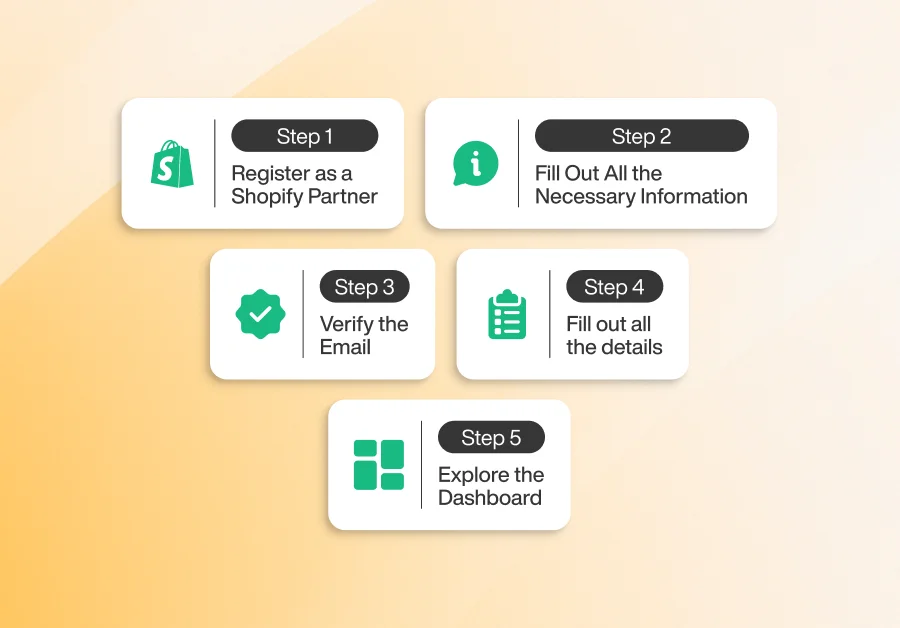 To become a Shopify Partner, visit Shopify’s Partner Program page, create or sign in to a Shopify account, set up your Partner organization, complete the required security and account details, and explore the Partner and Dev Dashboards. Shopify Partner sign-up is free, but Shopify may ask you to complete identity or security checks before you can use certain features. Now let’s see how you can actually become a Shopify partner in just 5 steps:
Step 1: Register As a Shopify Partner
First, search for the Shopify Partners webpage. There, you will immediately find the option to ‘Become a Partner’.
Click the button to go to the page. There, enter your email and continue to the next page. Fill out your Name, Last Name, and password, then click the Create Account button.
Step 2: Fill Out All the Necessary Information
As soon as you hit the Create Account button, it will direct you to a page where you can select whether to create a new partner organization or join an existing one. Select the 'New Partner Organization' button if you are starting as a complete beginner.
Then, fill out information such as your main focus as a partner, your business location, and your contact details. After filling in all the details, hit ‘Create Partner Organization’.
Step 3: Verify The Email
A new window will open, and you will need to verify the email address you provided. A verification email will be sent to your email account with a button for verification.
Click the Verify email button, and your Shopify Partner Dashboard will open.
Step 4: Fill Out All the Details
After creating the partner account and opening the Dashboard, you will need to fill out some additional details. Add your store details in the dashboard. Include the method by which you will be paid and provide your service-related information. You can find all these details under the Settings option.
Step 5: Explore the Dashboard
Now you're done creating a partner account and working as a partner. At this stage, explore the dashboard and get familiar with the environment. With that, you are an official Shopify partner.
How Much You Can Earn From the Shopify Partner Program
Now, the most important part: how do you earn as a Shopify partner? It depends on the type of partner you are and how much effort you put into the partnership. Earning varies depending on whether you are a service partner or a Technology partner.
The Service partner program is designed for agencies, consultancies, and system integrators. In this role, you will help clients onboard, build, and migrate or design their Shopify stores. You will continue to provide consultancy, analysis, and performance improvement services.
By delivering crucial recurring services, you can grow. Shopify provides revenue to service providers, and as of July 1, it has expanded service partners' earnings. Now, you can earn from both recurring subscription fees and variable platform fees.
-
Service partners get a 20% monthly share when they create and transfer a new development store to a Shopify merchant. This revenue share remains in effect as long as the merchant and the partner remain active on the Shopify platform.
-
Partners receive a $2,500 one-time incentive upon submitting a qualified referral and working with Shopify sales to sell a Plus or Enterprise plan.
-
Partners can earn a 15% revenue share when they launch a new merchant through a qualified sales opportunity. This revenue share is counted based on whichever is higher: the merchant's base or the variable platform fee.
The Technology Partner program is for independent software vendors, application developers, resource planning providers, and other tech companies. With the Shopify App Store, you can launch your own app and join the millions of entrepreneurs around the world.
As a Technology partner, you will start by providing future-proof migration and integration services to the merchants. You will continue to provide strategies, integrations, and customized global storefronts that will boost sales. To grow as a Technology partner, you need to deploy advanced solutions and improve key merchant KPIs. A Technology partner's primary revenue source is creating and selling solutions.
-
You can earn 100% of the first $1 million USD by building a public app and monetizing it through the App Store. After the first $1 million, partners will receive 85% of the revenue.
-
You can also earn by developing and selling solutions and integrations directly to enterprises. To sell integrations, you'll need custom license and service agreements.
-
There’s also an opportunity to sell themes in the Shopify Theme Store. You can sell themes as a one-time purchase and earn 85% of the total revenue.
What Are the Benefits of Becoming a Shopify Partner?
Key benefits of the Shopify Partner program include extensive testing of various plans, access to the Shopify Academy, and a range of marketing and sales tools. Here are a few of the benefits you get from the program:
-
By becoming a Shopify Partner, you gain access to unlimited test stores. You don't need any paid plans to test and build stores.
-
Free access to Shopify Academy. This means you get access to all courses and certifications for free. Shopify offers this because it wants its partners to build their knowledge and capabilities.
-
The Shopify Partner program includes free marketing tools and materials to promote your services. This opens the door to reaching more merchants and growing your services over time.
-
As you level up, you get access to priority customer service. This means you can solve your own and your clients' issues quickly.
-
Shopify offers special discounts, tools, and apps for partners that you can use for various purposes.
-
The Shopify Partner Program gives you exposure toa global community, creating more opportunities for networking, collaboration, and learning.
Concluding Words
Becoming a Shopify partner isn't difficult and doesn't take much time. However, the partnership offers numerous benefits. Every level you rise, you get some additional benefits. Shopify's partner program has different levels you can unlock through various growth efforts. But you can always start your journey with minimal effort.
If you are looking for a platform that gives you exposure and the kick-start you need to launch your journey, look no further. No better option exists than the Shopify Partner Program. So don’t delay and start your Shopify Partner journey with the 5-step guide.
Frequently Asked Questions About Becoming a Shopify Partner
How much does it cost to become a Shopify Partner?
Creating a Shopify Partner account is free. You can join without paying a membership fee, though you may have separate business expenses for tools, software, or services you choose to use.
Do Shopify Partners get paid?
Yes. Eligible partners can earn through activities such as building and transferring stores, referring merchants, or selling apps and themes. Earnings, eligibility, and payout terms depend on the activity. Review Shopify’s current partner earning guidelines for details.
How do I become a Shopify Partner?
Create a Shopify Partner account, learn how the program works, choose the services you want to offer, and start building your experience and portfolio. Shopify’s getting-started guide explains the program’s steps and resources.
What can I do as a Shopify Partner?
You can help merchants create or improve their stores, refer merchants to Shopify, or develop apps and themes. The options that fit you depend on your skills and business goals. Learn more about ways partners can earn.
Can beginners become Shopify Partners?
Yes. You can start by learning Shopify, practicing with partner tools, and building a portfolio that demonstrates your skills. Begin with the services you’re comfortable providing and expand your expertise over time.
Do I need to be a developer to become a Shopify Partner?
No. Developers can build stores, apps, and themes, but partners can also offer services such as design, marketing, and consulting. Choose an area that matches your experience and the needs of the merchants you want to support.
How can I find clients as a Shopify Partner?
Create a portfolio that showcases your work, explain your services clearly, and connect with businesses that may need Shopify support. As you complete projects, add examples and results to your portfolio to help prospective clients understand what you offer.


